MFA thesis at the Pratt Institute(re)Crafting the Self is sculpturally informed arts-based research into how cultural identity formation is affected by diaspora, and how artistic practice can be an act of cultural reclamation.
Using methods such as abstraction, fragmentation, recomposition, and intentional illegibility, this work explores themes of diasporic identity, cultural belonging, otherization, queerness, and multiplicity.
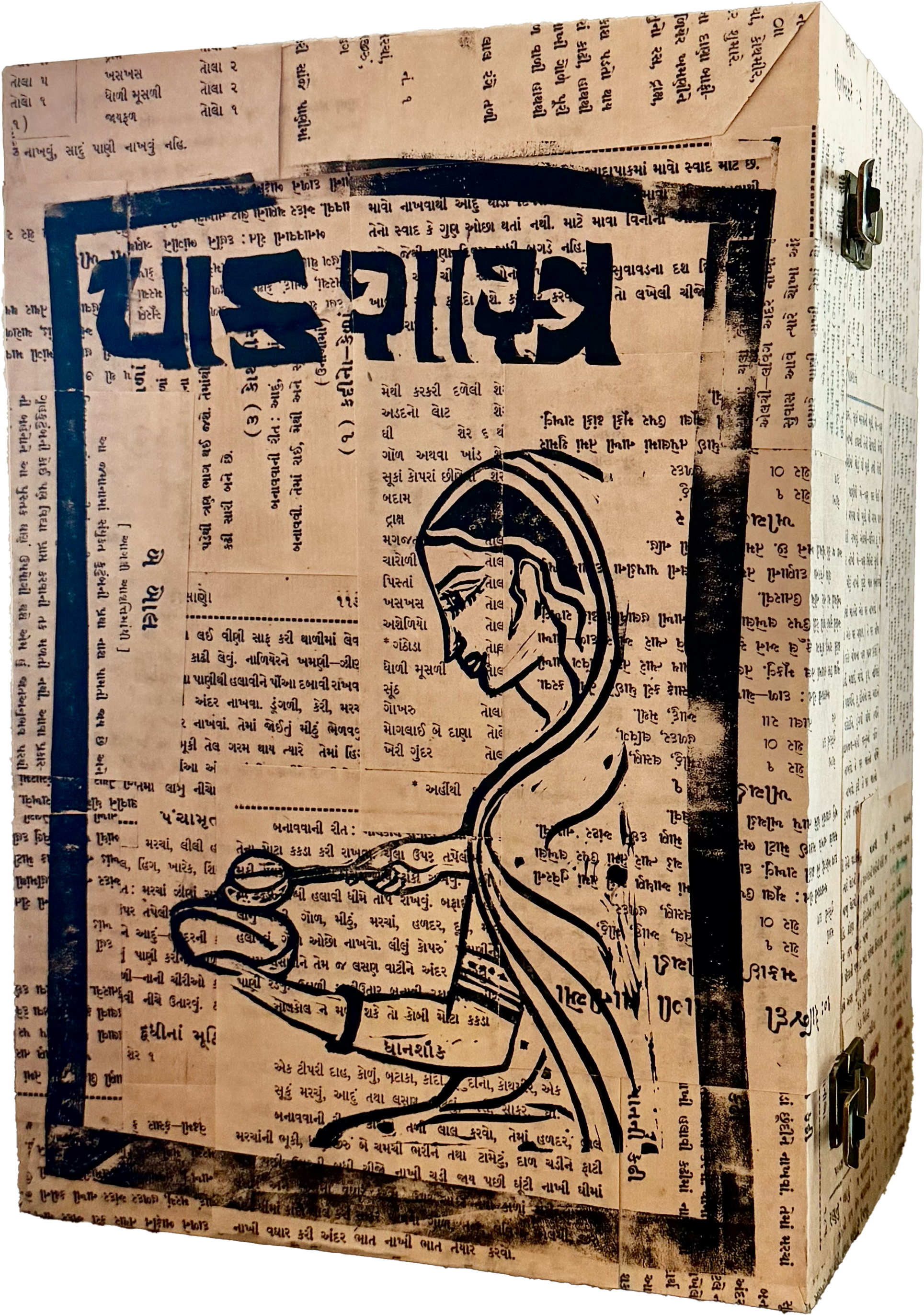
(re)Crafting the Self
-
(re)Crafting the Self, sculptural inquiry rooted in (re)connecting with and (re)affirming my Indian heritage through tactile engagement with physical cultural artifacts, challenges the mythology that diasporic identity must be singular to be valid, and asks how design can be utilized as a tool for identity reconciliation.
Through arts-based inquiry, (re)Crafting the Self explores how tactile engagement and embodied knowledge, working with and through cross-cultural artifacts, can externalise, elucidate, and often soften tension, proposing a new lens for holding the complexity of identity in integration, multiplicity, reverence, and relational coherence. Using methods such as abstraction, fragmentation, deconstruction, recomposition, and intentional illegibility, this work explores themes of diasporic identity, assimilation, cultural belonging, otherization, queerness, and multiplicity.
-
How design might be used as a reparative process to cultivate a sense of inner wholeness from the perspective of cultural identity reconstruction and/or reconciliation so that diasporic people are able to authentically integrate intersectional identities and find sense of harmony and cohesion within themselves?
How can diasporic individuals engage with design (through making) to reconcile, expand, and integrate their ethnic and cultural background so that they are able to feel more affinity with their ancestry through embodied cultural knowledge?
How can embedded cultural knowledge, learned through embodied making, empower diasporic individuals to facilitate societal and self integration to reclaim wholeness, reconcile ancestral backgrounds, and reestablish cultural ownership through grounded preservation of legacy?
How can queer theory and gender performativity be applied such that queer diasporic people can integrate their queer identity with their ethnic and transnational identities?
How is culture passed down through and across time, generations, and space? How does cultural knowledge get communicated and translated in the absence of language?
How can artifacts of design be used so that diasporic people feel an active and alive connection to the modern and ever-changing state of their ancestral culture to avoid cultural fossilization?
How can we physicalize the intangible (cultural identity and cultural connection) so that diasporic people feel more grounded in their cultural identity?
How can we reframe assimilatory tension such that parts of the self do not feel in conflict with each other, so that parts of the self are not in negotiation but instead peacefully coexisting?
How does engaging physically with a feeling (through analogue art practice) change one's relationship with that feeling?
How does queer gender performativity – and related self-affirmation of identity – compare or apply to the experience of the diasporic identity-performance rupture (i.e. the performance of “proving,” “verifying,” or otherwise trying to legitimize one’s cultural identity to an audience external to the self)?
How can design through making be used as a tool to empower diasporic people to feel more authentic in all parts of themself and reduce symptoms of cultural dysphoria, such as shame, guilt, and grief?
How can design empower diasporic people to forge a unique relationship with their cultural background to help establish a rooted sense of identity and authority over their culture?
-
Diaspora a population that has spread or been dispersed from its original homeland, often maintaining cultural ties to their place of origin
FOB (Fresh Off the Boat) derogatory term used to describe immigrants who have yet to assimilate into the chosen home culture, language, and behavior
ABCD (American Born Confused Desi) pejorative term used to describe second generation Desi immigrants, often by Indian residents or newer Indian immigrants, to denigrate diasporic Desis as “whitewashed,” while simultaneously lampooning diasporic Desis for feeling insecure or “confused” about their cultural identity
Assimilatory Tension the potent rift diasporic people experience that results in feeling both “too much” and “not enough” (too American + not Indian enough OR too brown/Indian + not American enough). A push and pull between two poles within the self, and the pushing and pulling motion/momentum + tension between the poles creates a cavernous gap between two “sides” of the self. This rejects holistic self identity and spurs feelings of guilt and shame
Diasporic identity-performance rupture the performance of “proving,” “verifying,” or otherwise trying to legitimize one’s cultural identity to an audience external to the self
Cultural Dysphoria a feeling of disconnect, alienation, or dissonance between an individual's cultural identity and their lived reality. It frequently occurs when a person identifies with a specific heritage but struggles to fully embody it
Cultural Fossilization diasporic populations often preserve cultural traditions, language, and values exactly as they existed when they emigrated. While culture and society in the country of origin continue to evolve, the diaspora inadvertently develops a time capsule of past customs, sometimes resulting in a generational disconnect between diasporic people and their peers in the country of origin.
Cultural Fraudulency a feeling of shame [that results from assimilatory tension] based in inferiority where diasporic people feel “less Indian” or “not really Indian” due to real/felt lack of cultural knowledge and acumen
Cultural Disenfranchisement a feeling of grief that arises from diasporic people feeling disconnected from their ancestral culture and a lack of “valid” ownership/expertise over cultural artifacts and cultural identity
Cultural Relational Strengthening a process of tactile engagement with cultural artifacts aimed at alleviating cultural fraudulency + disenfranchisement by using reconstruction + abstraction + distortion as methods to diffuse shame + grief while building a materially rooted connection with the cultural artifact to move toward identity reconciliation, healing, and self-acceptance
Cultural Fluency when diasporic people feels more rooted in their cultural identity due to learned and/or embodied cultural knowledge
Identity reconciliation the continuous, psychological process of integrating heritage culture with other aspects of diasporic identity. It involves moving past the feeling of "living in-between" to forge a unique, hybrid sense of self that embraces both your roots and your lived reality
-
Assimilatory Tension and Cultural Identity Formation
I am Indian-American. Part of the Indian diaspora, I, like many people who hold multiple cultural identities, have often felt in-between worlds, seemingly always incongruent with those around me. Too American, too Indian, too much of both, or not enough of either.
My parents raised me to be proud of my heritage – realizing that I would be growing up in predominantly white areas, they made it a point to emphasize to me from a young age that I cannot change the color of my skin nor where I’m from, nor do I need to want to change those things about myself because there is nothing wrong with those attributes, and in fact I should be proud of my ancestry, never ashamed. And I am very proud of my heritage: I feel a deep sense of pride that I come from a culture that has nurtured so many artforms from textile, to printmaking, to painting, to sculpture, to jewelry, and countless others. My personal sense of aestheticism has been deeply influenced by my culture as I have grown up surrounded by Indian art in my home. Indian art has also felt like an accessible way for me to grasp at a sense of cultural belonging that has always felt elusive.
I have often felt a sense of disquietude about my cultural identity and cultural belonging that revolves around my inability to speak any of the Indian languages my parents speak: Hindi, Marathi, and Gujarati. This view of myself has been reinforced by countless jokes – by uncles, aunts, cousins, and sometimes Desi strangers too – made at my expense, how I’m “Americanized” and “not really Indian” due to my linguistic shortcomings, and somehow also created an entrenched belief that for me artistic influence and appreciation is somehow not enough to legitimize my cultural identity. I feel a need to prove my own cultural identity, and want to explain myself and my identity, maybe especially because I am unable to do so in my mother’s tongue.
However, the most tender nuance of my diasporic identity is that I do not wish to live elsewhere – I love my city, I love New York. Much of that love is derived from the knowledge that as a queer person of color, there are few places in the world where I can live as openly and freely as I can here in my beloved home. Thus outlines my case of assimilatory tension, equally Indian, American, lesbian, and feeling friction between these identities. I feel that this tension, this friction is very interesting and what I have researched through this work. The crux of this work is finding a way to balance and neutralize assimilatory tension to come to an internal state of equilibrium, which is to say that this work is concerned with disavowing and rejecting the concept of mutual exclusivity as applied to cultural identity.
Significance of Cultural Relational Strengthening in Identity Reconciliation
The significance of cultural relational strengthening cannot be overstated. My work asks, among other questions, how design might be used as a reparative process to cultivate a sense of inner wholeness from the perspective of cultural identity reconstruction and/or reconciliation so that diasporic people are able to authentically integrate intersectional identities and find a sense of harmony and cohesion within themselves.
Cultural relational strengthening, as a path for diasporic people to move toward identity reconciliation, is important because it ultimately is an exercise in allowing diasporic people the opportunity to fully connect and integrate all parts of themselves, and asks how design might be used as a reparative process to cultivate a sense of inner wholeness from the perspective of cultural identity reconstruction and/or reconciliation so that diasporic people are able to authentically integrate intersectional identities and find sense of harmony and cohesion within themselves. This work of identity reconciliation and integration is essentially a framework through which to cultivate a radical sense of empathy and self-acceptance.
This is a clear parallel to the queer experience: live openly and proudly, queer people go through a personal metamorphosis. Deciding to live happily and proudly in your truth as a queer person while existing in an inherently homophobic + heteronormative society is an act of radical self love and self acceptance that, I believe, allows queer people a prism through which to access a greater wealth of empathy for themselves and others. The parallel I am drawing here is that diasporic people will be able to utilize this process of cultural relational strengthening to develop a true/real attitude of self-acceptance, which begets a rich sense of empathy for the self and others.
Cultivating empathy is especially important when we consider some of the larger forces at work in society at the moment: there is a crusade against intellectualism and critical thinking which rejects, on a personal level (for individuals and society), nuance and empathy in self and others, which drives up divisiveness and hatefulness between people as a result of the inability to imagine complexity in strangers.
We exist in a capitalistic society that values the production of labor above all else, and often explicitly devalues critical thinking and self-reflection, thus people are not given the space to develop a sense of self-compassion (which requires introspection and critical thinking). Cultural relational strengthening is both a framework for diasporic people to develop a sense of cultural fluency through tactile interaction with a physical cultural artifact, as well as a conductive process through which diasporic people can cultivate empathy and self-compassion; the greater sense of empathy and understanding is a “halo effect” that results from the reparative identity reconciliation work at the heart of cultural relational strengthening.
Identity reconciliation is important to me, in the context of the Indian diaspora, because I believe if we do not address the issue of cultural dysphoria, cultural fraudulency, and cultural disenfranchisement then diasporic community will not be not empowered to take ownership of our culture, which will create systematically static, fragile, and precarious relationship between diaspora populations and their ancestral culture until eventually cultural ties are severed.
That begins the end of the lineage of cultural stewardship and accelerates the erosion and eventual erasure of culturally significant design. This will then accelerate the existing problem of lack of accreditation to design styles, motifs and compositions existing in a vacuum that eradicates cultural context, creating a vicious cycle where people do not believe they are appropriating culture due to the existence and proliferation of this appropriative work. I feel a sense of urgency around finding a way for diasporic Desi people to feel more authorship and connectivity to their culture so that we are able to speak on Indian motifs and art to help socially codify our people’s contributions to the global design cannon and everyday vernacular around global design influence before globalization erodes away the ethnic roots of different art forms in support of a Eurocentric worldview.
-
Sculptural Inquiry: Process of Physicalization
This work explores a series of intangible and invisible themes – diasporic identity, assimilation, cultural belonging, otherization, queerness, and multiplicity – and is concerned with the concept of tension within the self, as a symptom of diasporic cultural dysphoria, and the role of physicalization in the alleviation of assimilatory tension and cultural dysphoria.
Since a key aspect of my personal sense of cultural fraudulency and disenfranchisement revolves around linguistic incapability, I knew language would need to be present in my process. I also knew that I wanted to explore the role of physicalization. I combined the two in a series of paper mache works that used scans of the internal spreads from my great-great-grandmother’s Gujarati cookbook alongside foundational spices for Gujarati cooking in the paper mache batter of each piece.
Through my process, I found that physicality and tactility – explored through sculptural form – were key instrumental in not only dispelling feelings of shame, grief, and inadequacy, but also in developing a more rooted and personally resonant relationship with my cultural identity that allowed for a grounded sense of authority and fluency over my own culture, ultimately opening a path to ward identity reconciliation.
The tactility of the sculptural work, combined with interacting with a physical expression of culture through a 3D object, allowed me to cultivate a relationship with my culture that felt active, alive, personal, and defined on my own terms.
Abstraction, Fragmentation, and Reconstruction as Methodology
In the work of cultural relational strengthening, abstraction plays a key role because it does not undermine the shame and grief that are the basis of cultural fraudulency and cultural disenfranchisement, respectively, and instead diffuses and dismisses those critical self-reflections on cultural identity.
By centering the “missing” or otherwise inaccessible cultural information of ancestral language through the physical presence of the cultural artifact (my great-great-grandmother’s cookbook, which was published in Gujarati, which I cannot read), which contains intrinsic tacit knowledge, and then purposefully obfuscating the knowledge through methods like abstraction, fragmentation, distortion and reconstruction, this work does not undermine, discount or ignore the shame and grief that are the bedrock of cultural fraudulency and cultural disenfranchisement and instead neutralizes those feelings through gentle interaction.
For diasporic people to relinquish the shame of cultural disenfranchisement and grief of cultural fraudulency, we must physically interact with culture to create a rooted connection with a cultural artifact, that acts as a knowledge bearer or tacit cultural learnings, while using abstraction to obfuscate legibility to demonstrate the enduring nature of cultural connection regardless of illegible, inaccessible, or redacted information.
Opacity and Intentional Illegibility as Transformation
Additionally, this thesis emphasized to me the importance of self-affirmation of identity as the bedrock of secure self-concept in that identity, as well as the power of personal opacity. Through the experience of working on this body of work, I came to understand that my identity is mine to interact with and there is no need to overly explain myself so long as what I’m creating feels intuitively correct and culturally aligned.
Minimizing explanatory artifacts to accompany the abstract work pushed me to stand firm in my own cultural identity and to find a secure sense of confidence within myself that withstands external scrutiny. This process reaffirmed the importance of self-affirmation of identity, and works to help me devalue the external perception of how I engage with my cultural identity.
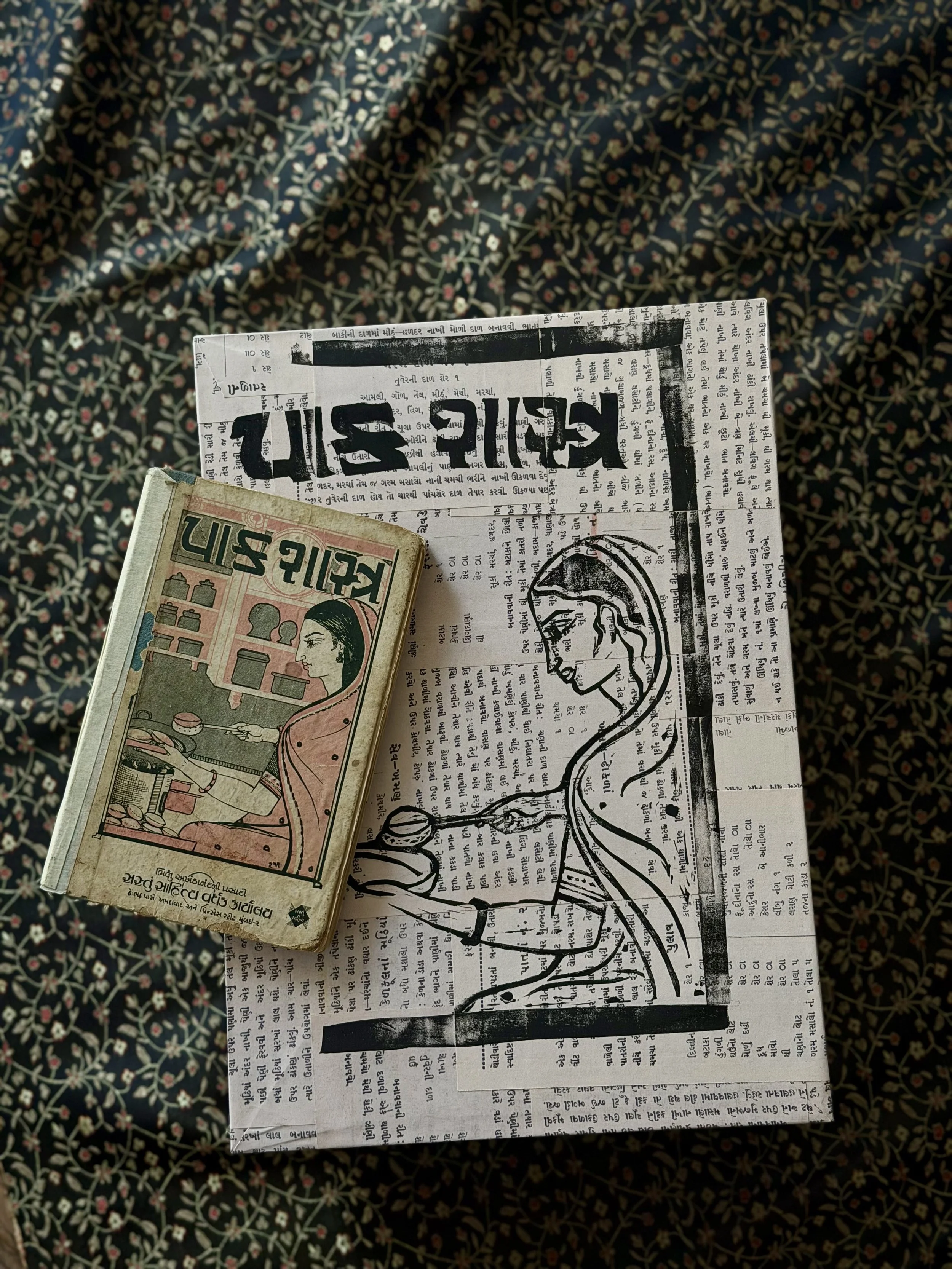
(re)Crafting the Self, here with the source material and inspiration, a Gujarati cookbook written by my great-great-grandmother titled Paak Shastra. Both are pictured against the same fabric that lines the inside of (re)Crafting the Self.
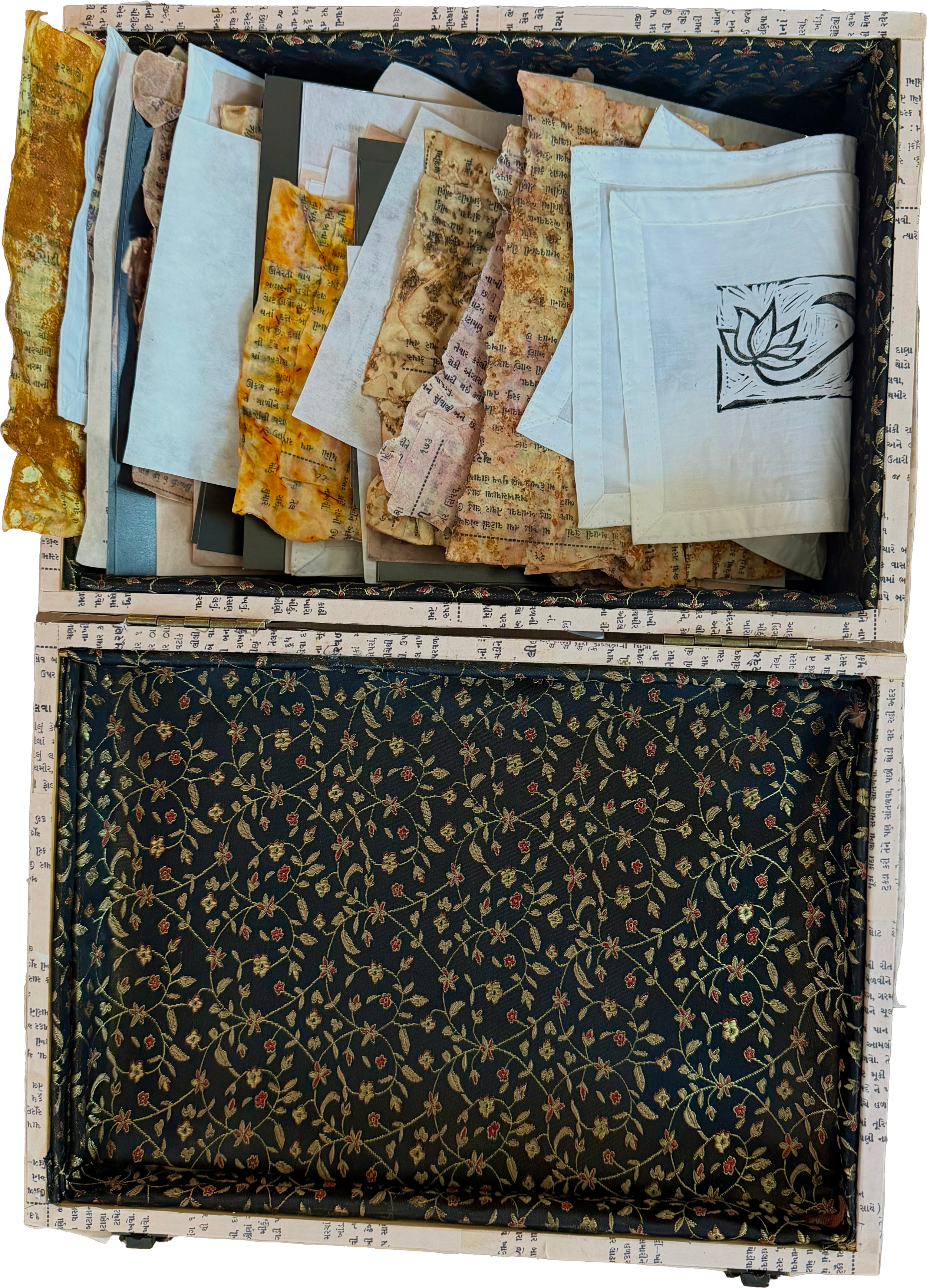
(re)Crafting the Self reconceptualizes a book as a sculptural container. Here the box-as-book is pictured open showcasing the materiality of its contents
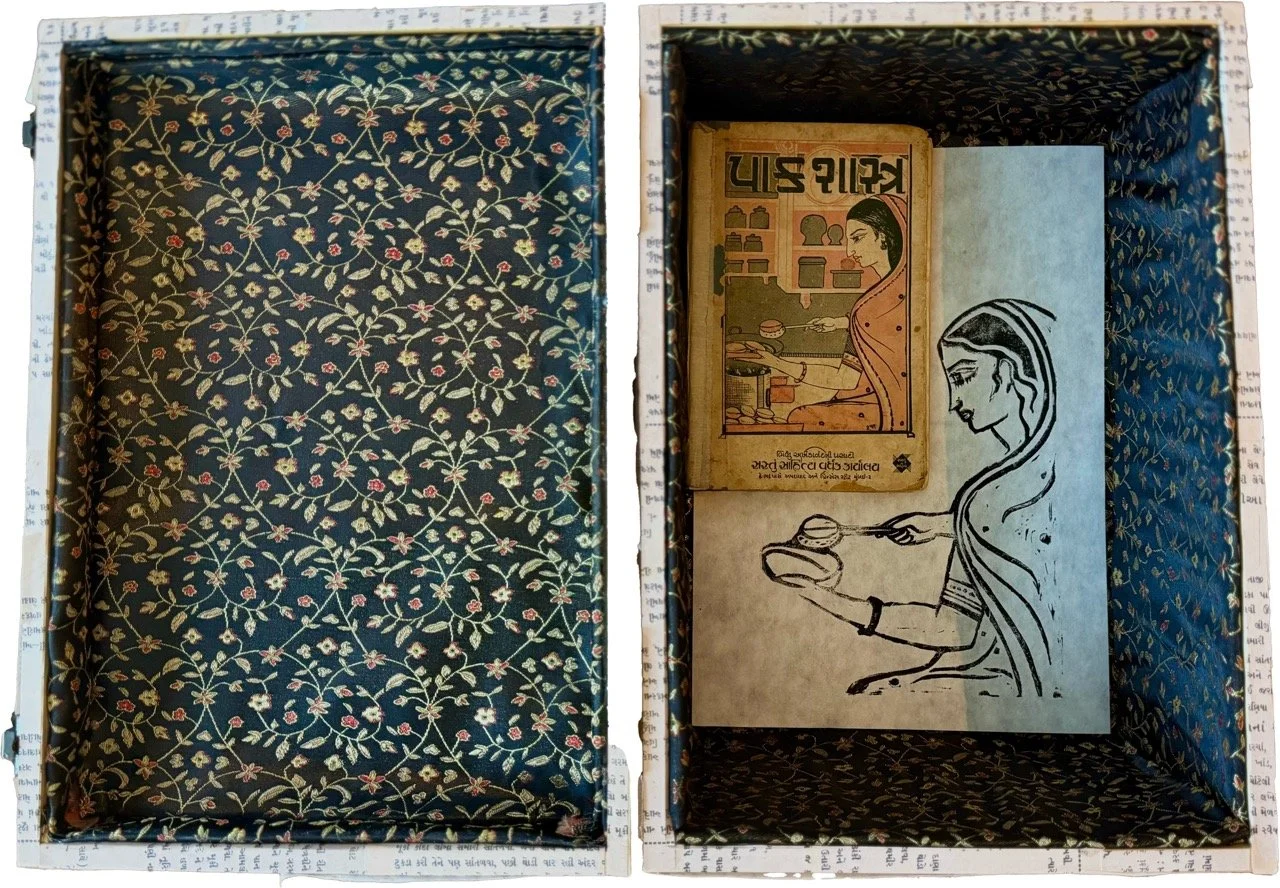
(re)Crafting the Self, pictured open. The box is lined with Indian brocade silk, pictured here containing Paak Shastra (the source material for (r)CS) and an printing of a blockprint style stamp that is an interpretation of the cover of Paak Shastra. (stamp featured on the outside of (r)CS as well)
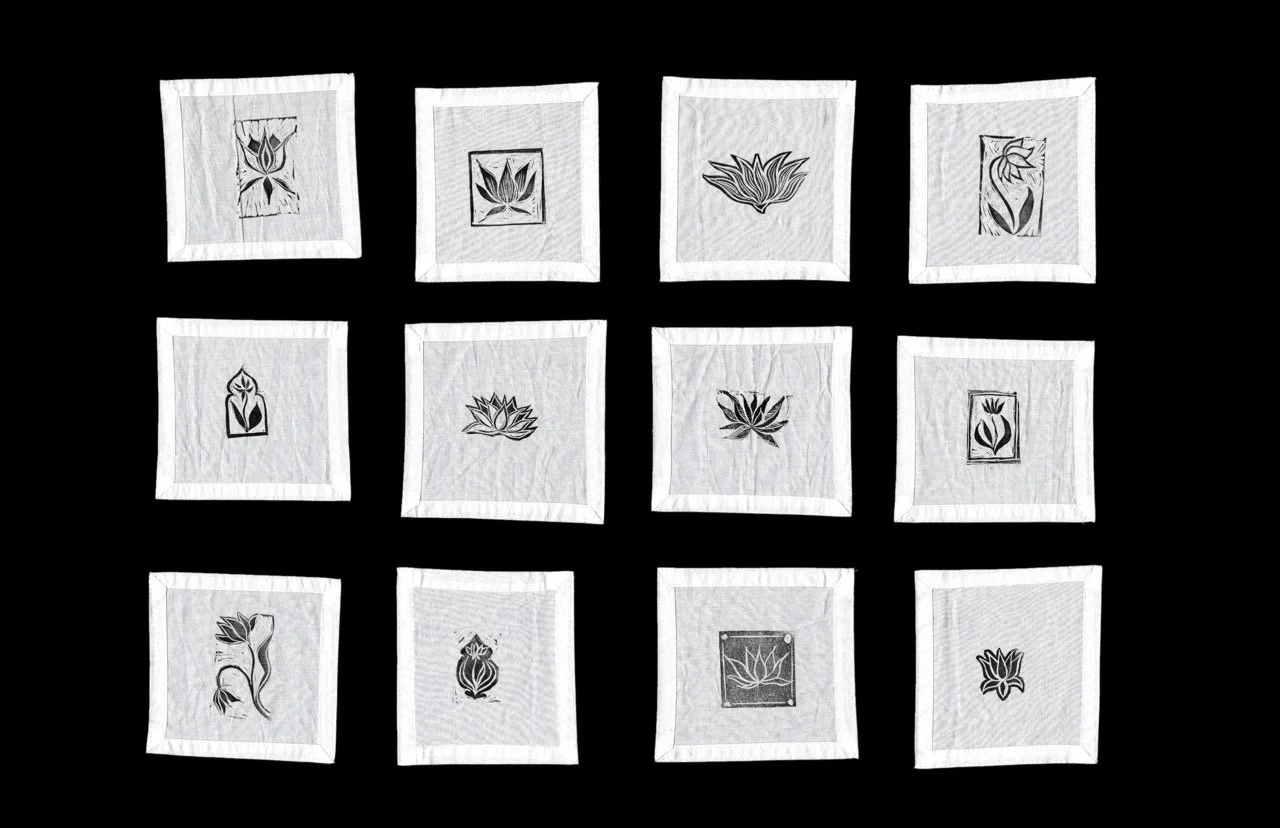
Lotus Napkin Series, one of the three series of material connectivity explored in (re)Crafting the Self
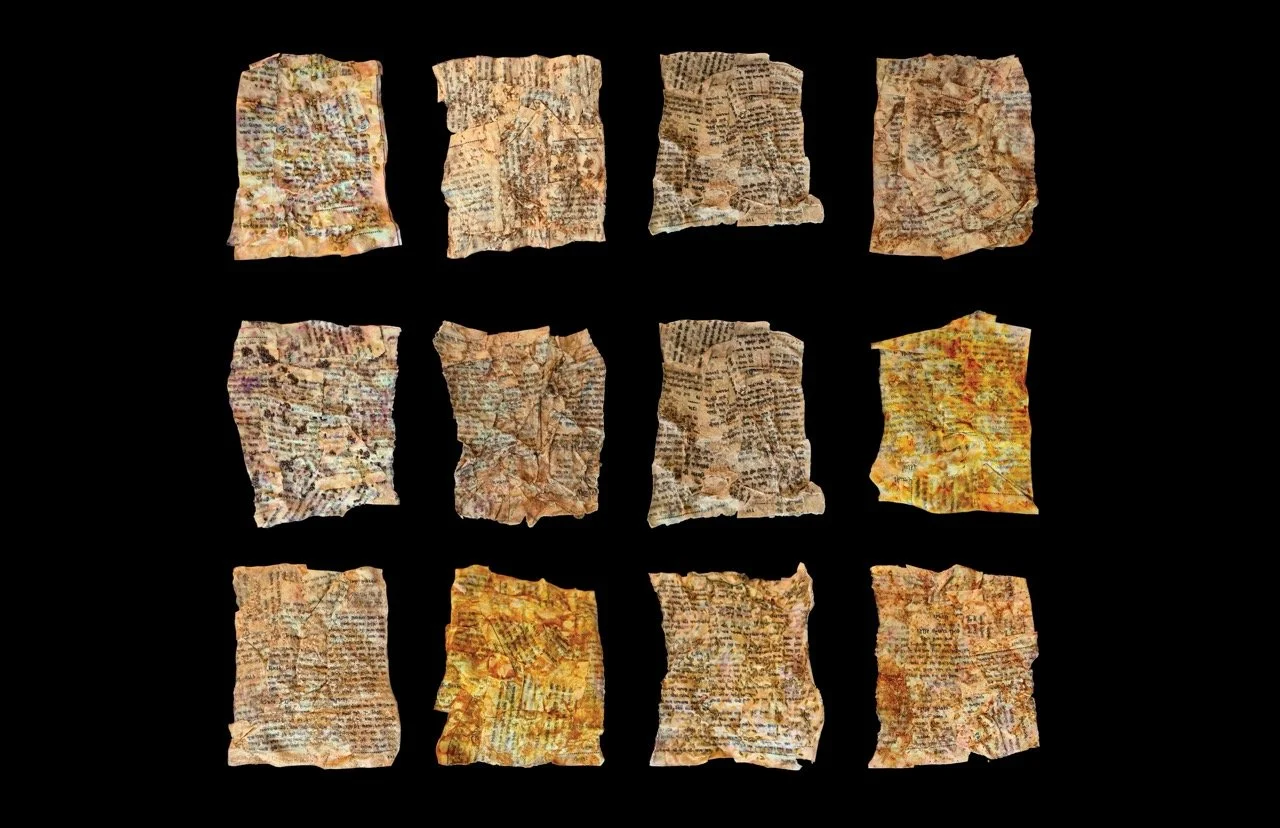
Spice Sheet Recipe Cards, one of the three series of material connectivity explored in (re)Crafting the Self
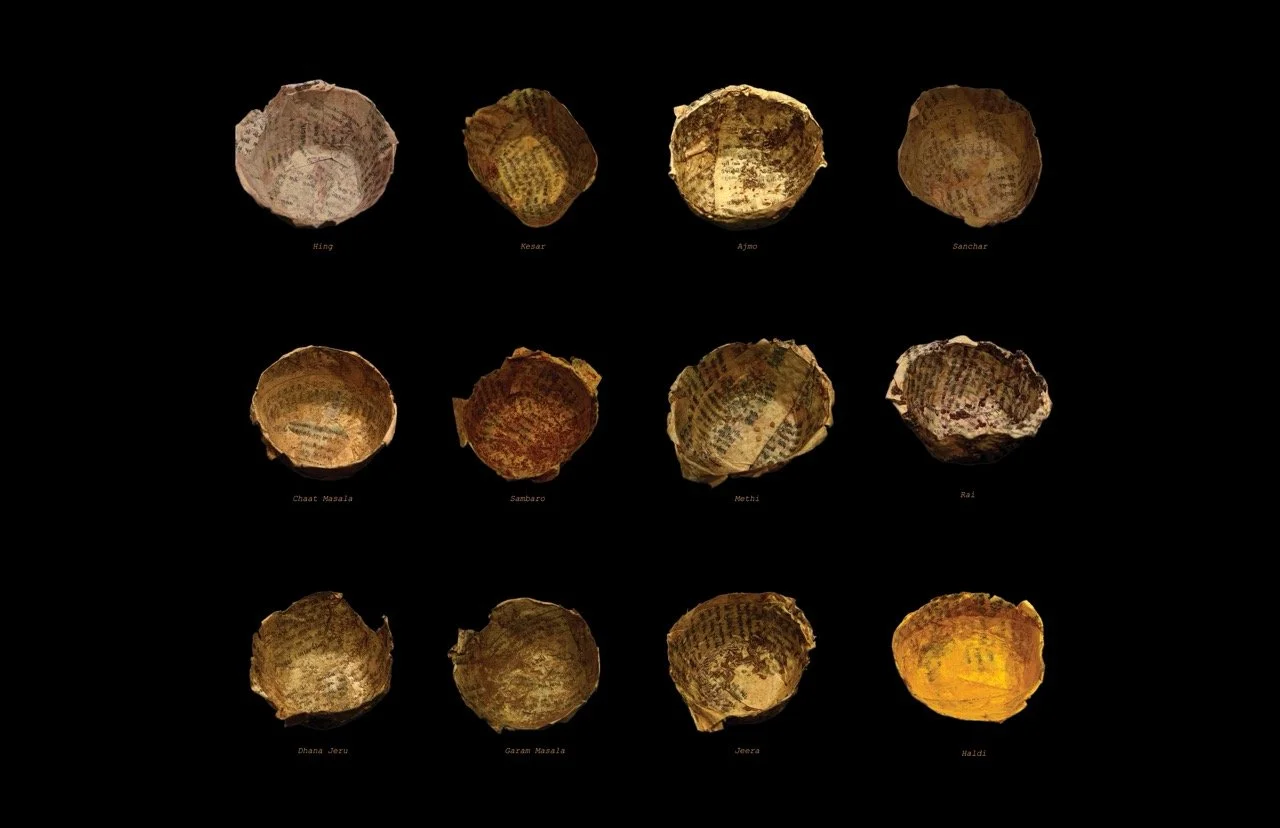
Spice Bowl Series, one of the three series of material connectivity explored in (re)Crafting the Self